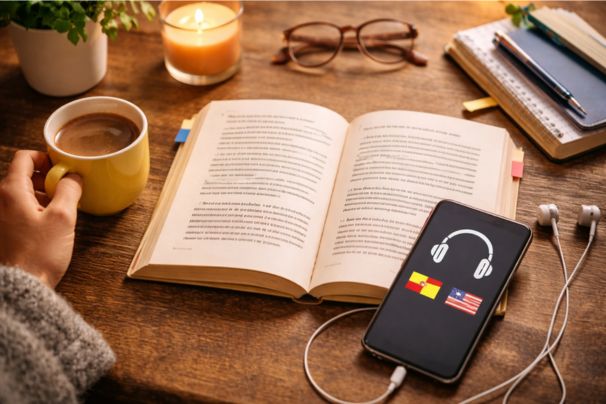

Learning Spanish often feels like a stop-start journey. One week you’re motivated, the next you’re overwhelmed. But what if progress didn’t depend on long study sessions at all? What if just ten minutes a day could quietly sharpen your Spanish skills? That’s exactly where daily story reading comes in — simple, consistent, and surprisingly powerful.
Many learners now choose to Learn Spanish by Reading Stories because it removes pressure. No memorizing long word lists. No grammar overload. Just language flowing naturally — the way it’s meant to be absorbed.
Why Stories Speak to the Brain Differently
Our brains are wired for stories. Long before textbooks existed, humans learned through narrative — listening, imagining, and connecting meaning emotionally. When you read a short Spanish story, your brain doesn’t treat it like “study.” It treats it like experience.
According to cognitive research shared by Harvard University, narrative-based learning activates multiple areas of the brain at once, improving retention and comprehension far more effectively than isolated vocabulary drills (harvard.edu).
Also Read: The Top Advantages of Becoming Bilingual in Today’s World
How Daily Story Reading Improves Your Spanish Skills
1. Vocabulary Grows Naturally
Instead of memorizing random words, stories introduce vocabulary in context. You don’t just learn what a word means — you understand how it behaves.
- Words repeat naturally across different stories
- Meanings become intuitive instead of translated
- You start recognizing patterns without effort
This repetition-with-meaning is one of the strongest foundations of language fluency.
2. Grammar Starts Making Sense (Quietly)
Most learners struggle with grammar because they try to understand rules before seeing them in action. Stories flip that order.
As you read daily, verb tenses, sentence structure, and connectors begin to feel familiar. You may not even know the rule — yet you instinctively feel when something “sounds right.”
That’s not accidental learning. That’s acquisition — the same way children learn languages.
3. Reading Builds Listening and Speaking Faster
Here’s something many learners don’t expect: reading improves speaking.
When stories are paired with audio or internal reading rhythm, your brain begins to store entire sentence patterns. Later, when you speak, you’re not translating — you’re recalling.
This is why story-based learning is often considered the Fastest Way To Learn Spanish for busy adults who don’t have time for daily classes.
Consistency Beats Intensity Every Time
Ten minutes daily beats two hours once a week. Language thrives on exposure, not exhaustion.
Daily story reading works because it:
- Keeps Spanish present in your mind
- Reduces forgetting between sessions
- Builds confidence through familiarity
It’s similar to fitness — short daily movement builds strength better than occasional overload.
Why Short Stories Work Especially Well
Short stories remove friction. You can finish one before motivation fades.
They give closure, which triggers a small dopamine response — the brain’s “reward chemical.” That sense of completion encourages you to come back tomorrow.
This is exactly why many learners start with a free 4-story pack — it builds momentum without pressure.
Real Progress Feels Quiet at First
One of the most beautiful things about daily reading is that progress sneaks up on you.
One day, you realize you didn’t translate a sentence.
Another day, you understood a paragraph instantly.
Then suddenly, Spanish doesn’t feel foreign anymore.
That’s when confidence appears — not loudly, but steadily.
FAQ
How long should I read Spanish stories each day?
Even 10–15 minutes daily is enough. Consistency matters far more than duration.
Is story reading good for complete beginners?
Yes. Beginner-friendly stories with simple language and translation support are ideal for starting naturally.
Should I translate every word I don’t know?
No. Focus on understanding meaning from context. Only check words that repeat or block comprehension.
Can reading stories replace traditional lessons?
Stories may not replace grammar study entirely, but they dramatically strengthen comprehension, fluency, and confidence.
Final Thoughts
Daily story reading doesn’t feel like studying — and that’s exactly why it works. When Spanish becomes part of your routine rather than a task, progress follows naturally. One story a day may seem small, but over time, those moments compound into real understanding, real confidence, and real fluency.
Also Read: Why Bilingual Stories Make Spanish Stick
Blog Development Credits
This blog was a team effort fueled by smart ideas. Dual Language Stories picked the topic. Most content was crafted using tools like ChatGPT and Google Gemini.